The Challenge
Simplifying Fragmented Music and Voiceover Production
Teams needed a faster and more reliable way to create music and voiceovers without moving across disconnected tools or depending on slow manual production cycles. Audio production was slow, fragmented, and dependent on multiple tools for ideation, generation, recording, review, and storage. Creative teams often had to manage several disconnected processes to move from an initial concept to a usable audio asset.
The growing demand for digital campaigns, branded media, product demonstrations, and short-form content also increased the need for faster audio experimentation. Teams required a more streamlined way to create, refine, and manage music and voiceovers while maintaining flexibility throughout the creative process.
Key challenges included:
- Slow audio production: Finding music, recording voiceovers, and preparing final assets required too much manual effort.
- Too many tools: Ideation, script writing, generation, review, download, and storage often happened across separate products.
- Robotic voice quality: Existing AI voiceover tools often produced voices that sounded less natural than expected.
- Limited iteration: Creative teams needed a faster way to refine prompts, scripts, voices, tone, and production settings.
- Scattered outputs: Generated audio files and previous sessions were difficult to reuse when stored outside one workspace.
- High campaign effort: Short-form campaigns, demos, explainers, and branded media needed quicker audio experimentation.
Codimite's Solution
A Unified AI-Powered Workspace for Music and Voiceover Creation
Codimite shaped Melos into a secure AI-powered platform that brings music generation, voiceover production, creative refinement, session history, and cloud-hosted audio delivery into one unified workspace. The solution allows users to move from an initial creative concept to playable audio through a structured product experience. Instead of relying on separate applications for script development, generation, review, and asset storage, Melos connects these activities within one platform.
The application supports two primary production workflows: AI music generation and AI voiceover creation. Each workflow includes dedicated capabilities tailored to its creative requirements, while sharing the same secure access and cloud-based asset management foundation.
AI Music Generation Workflow
The music creation workflow enables users to develop an initial idea into a structured music prompt or script before generating audio. Users can:
- Enter a text idea.
- Generate a structured music prompt or script with AI.
- Refine with feedback.
- Produce, preview, and download the audio output.
By supporting prompt refinement and iterative generation, the platform allows creative teams to experiment with different ideas before selecting a final audio output.
AI Voiceover Creation Workflow
For voiceover production, Melos provides dedicated controls for dialogue structure, voice selection, and expressive delivery. Users can:
- Create a voiceover session.
- Add dialogue blocks and assign AI voices.
- Insert expressive tone tags.
- Apply audio profiles and director notes before generation.
These capabilities provide greater control over how AI-generated dialogue is delivered. Rather than relying only on plain text input, users can configure voices, tone, and production guidance to support more expressive voiceover generation.
Technical Architecture: AI Music and Voiceover Generation
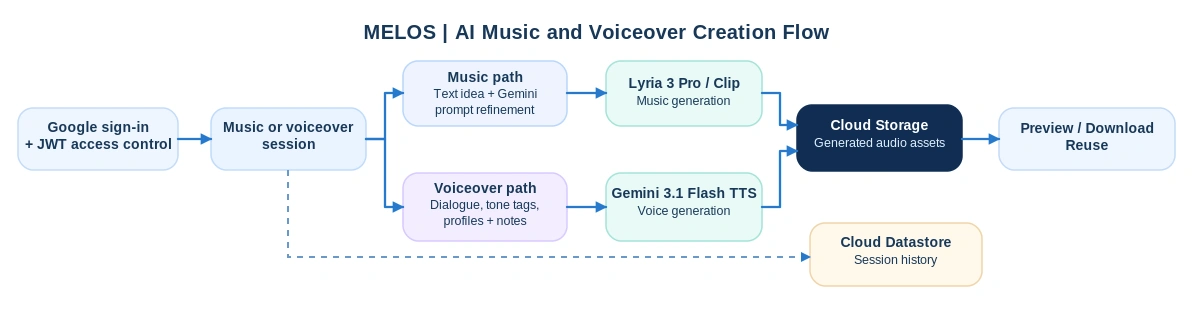
The platform combines AI script generation, advanced music and voice models, cloud persistence, secure access control, and hosted audio delivery into a unified cloud-based architecture.
Gemini supports script and prompt generation, helping transform creative input into structured content for audio production. Lyria 3 Pro / Clip supports AI music generation, while Gemini 3.1 Flash TTS powers voiceover generation. The platform also integrates Google authentication and JWT-based access control to support secure user access. Personal user data is handled with an emphasis on encryption, while Google Cloud Datastore maintains music and voiceover session history. Google Cloud Storage provides centralized storage for generated music and voiceover assets. This allows users to preview, download, manage, and reuse their audio outputs without leaving the platform.
A Connected Creative Production Experience
Beyond AI generation, Codimite built the supporting capabilities required to manage the broader audio production process. The solution follows five connected stages: Sign In → Create → Refine → Generate → Manage.
This workflow brings together secure authentication, creative inputs, AI model interactions, audio generation, cloud storage, and session management.
By connecting these components within a single application, Melos provides a more consistent environment for ongoing creative production. Users can return to previous sessions, refine their inputs, and manage generated assets through one cloud-based workspace.
Business Impact
Faster, More Flexible AI-Powered Audio Production
The solution established a secure, cloud-based platform that simplifies music and voiceover creation while supporting ongoing creative refinement and centralized asset management.
Key business outcomes included:
- Faster Creation: Users can move from idea to playable music or voiceover audio in one guided product flow.
- Better Iteration: Creative teams can refine scripts, voices, tone, profiles, and director notes before final output.
- Centralized Assets: Music, voiceover generation, session history, and generated files are managed in one cloud platform.
By consolidating audio generation and management into one application, Melos reduces the complexity of working across disconnected production tools.
The platform also provides a scalable foundation for AI-powered creative workflows, allowing users to generate, refine, store, and reuse audio assets as their content production requirements evolve.


