The Challenge
Enterprises are already adopting AI, but usage often happens through disconnected tools, personal chat histories and unmanaged automations. Codimite set out to close this gap by giving organizations a governed workspace for AI agents and AI-powered workflows.
- Fragmented AI usage: AI use was spreading across employees, tools and individual chat environments.
- Governance before access: Sensitive business workflows needed controls before AI agents could safely reach emails, files, calendars, developer tools and third-party systems.
- Enterprise assurance: Leaders needed auditability, access control, credential protection and operational kill-switches before scaling autonomous workflows.
- Lost knowledge: Teams needed to keep reusable prompts, operating patterns, workflow memory and agent skills even when employees changed roles.
Codimite's Solution
Codimite shaped CommandLyne into a secure control layer for enterprise AI adoption. It lets administrators decide who can access which agents, models, tools, workflow actions, memory scopes and integrations, while keeping teams productive with everyday AI support.
A secure AI workspace for governed agentic work
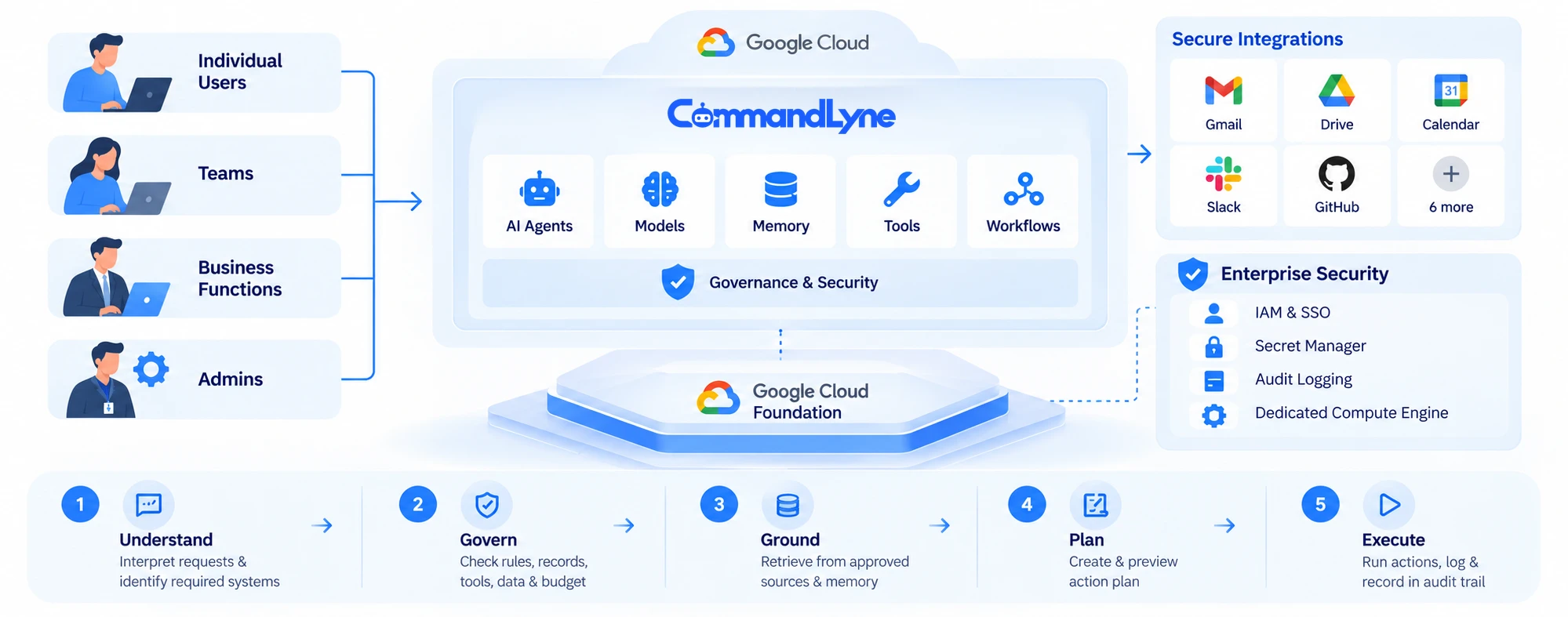
- AI Agent Workspace: Dedicated AI agents can be created for individuals, teams and business functions, with defined roles, models, memory, tools and automation policies.
- Model Control Layer: Admins can assign cost-effective or advanced models by role and task, reducing uncontrolled model usage while protecting output quality.
- Enterprise Knowledge Layer: Team skills, memory, workflows, prompts and reusable patterns are retained as long-term organizational assets.
- Workflow Builder: Natural-language instructions become structured, reusable workflows, with review-before-execute controls for automations.
Enterprise-grade architecture and governance
- Google Cloud foundation: A dedicated Google Cloud deployment approach with Google Compute Engine runtime isolation, Google IAM, Secret Manager and Cloud Audit Logging.
- One user, one VM: Each user gets a dedicated runtime environment, reducing shared memory and runtime risk compared with uncontrolled multi-tenant agent setups.
- Identity and RBAC: Google Workspace SSO, role-based access control, user-to-agent mapping and admin-defined tool permissions create clear boundaries.
- Audit and observability: Prompts, tool usage, external API calls, provisioning events and automation activity are logged for compliance review and operational visibility.
- Automation channels: Agents work through the web UI and channels such as Slack and Discord, with consistent model and tool policies.
- Credential protection: API keys, tokens, logs and backup artifacts are protected with Google Secret Manager and AES-256 encryption at rest.
How a request is governed from start to finish
Every request moves
through the same controlled path.
- Understand: The request is interpreted and the required systems and steps are identified.
- Govern: The platform checks the user’s role, approved models, available data, tool permissions and budget rules.
- Ground: Relevant information is retrieved from approved sources and permitted personal or team memory.
- Plan: An ordered execution plan is created and previewed.
- Execute: Approved actions run across connected tools and are recorded in the audit trail.
Business Impact
CommandLyne moves enterprise AI from scattered experimentation to governed adoption, and gives Codimite and its customers a scalable foundation for AI workforces.
| Metric | Result |
|---|---|
| 40+ hrs | Weekly time reclaimed across automation, briefings and recurring workflows |
| 95% | Workflow accuracy target, reducing errors in repetitive workflow steps |
| 4–5 min | Agent provisioning, with a dedicated VM health-checked during setup |
| Days | Time to first production agent |
What the platform enables
- Governed adoption: Moves AI use from disconnected experiments to a single managed workspace.
- High-value use cases: Supports executive briefings, sales intelligence, Jira follow-ups, customer issue resolution, market intelligence and content generation.
- Higher productivity: Automates recurring knowledge work while keeping admin oversight in place.
- Lower organizational risk: Makes AI activity auditable, permissioned and easier to stop when needed.
- A scalable AI workforce: Agents, memory, tools and workflows are managed from one workspace.