Why Forward-Deployed Engineering Is Gaining Momentum in Enterprise AI
For years, enterprise IT initiatives followed a predictable playbook: core engineering teams built products in centralized hubs, hand-offs went to customer success managers, and system integrators handled on-site customization.
However, as organizations shift from basic conversational LLM demos to complex, autonomous agentic workflows, this traditional model is fracturing. Off-the-shelf software and generic REST integrations rarely survive contact with legacy corporate infrastructure, fragmented data schemas, and strict enterprise security boundaries. As we explored in our benchmark analysis of how Gemini 4 Argon signals a shift from AI answers to AI execution, modern AI requires continuous, multi-hour production execution rather than static prompt-and-response interactions.
Enter Forward-Deployed Engineering (FDE), an operational model pioneered by companies like Palantir and now rapidly becoming the gold standard for enterprise AI implementation.
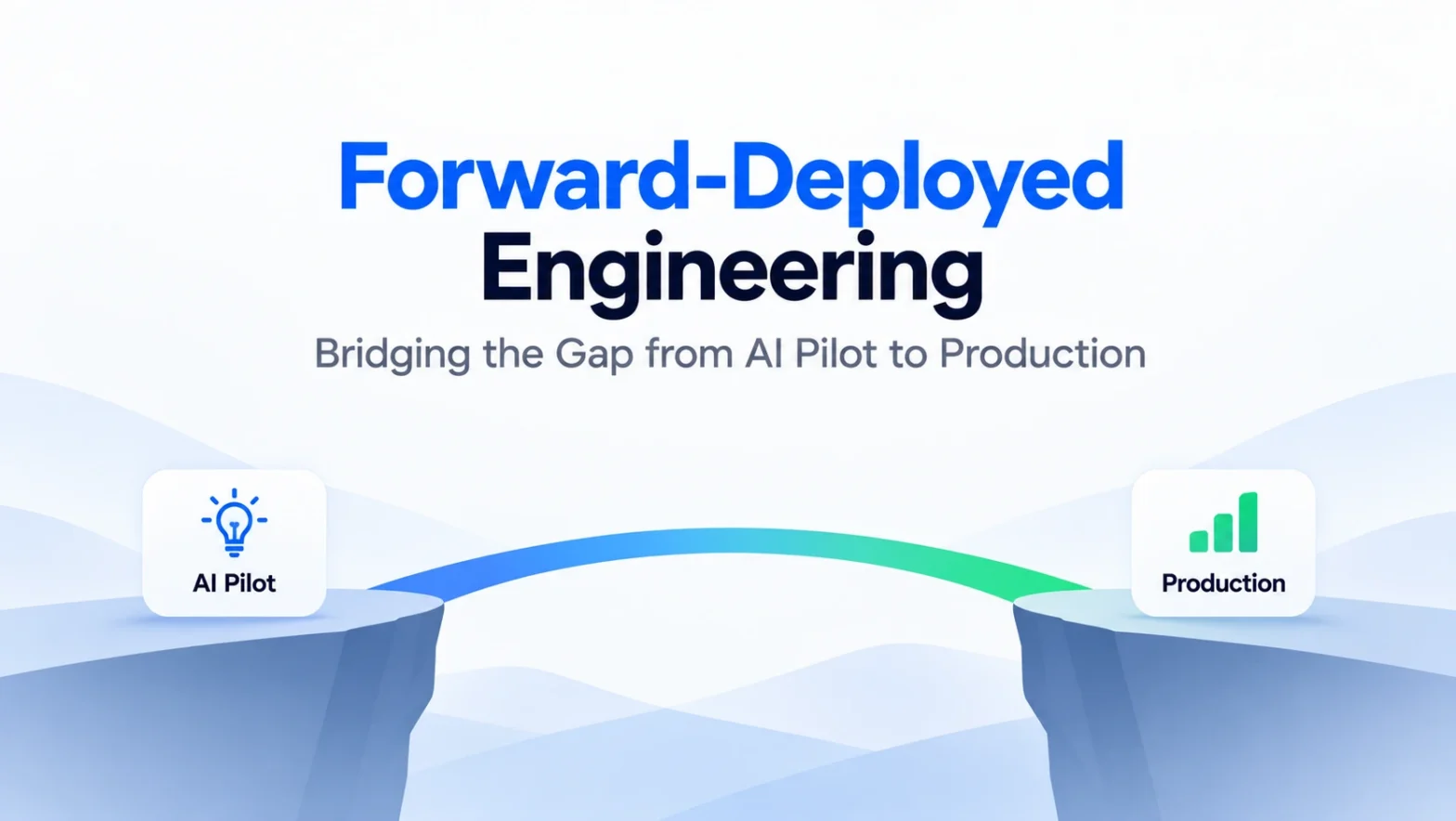
By placing senior, hands-on software engineers directly alongside client teams, forward-deployed engineering bridges the gap between frontier AI technology and production-ready enterprise execution.
1. What Is Forward-Deployed Engineering?
At its core, Forward-Deployed Engineering embeds technical engineers directly within a client’s business environment to solve high-stakes operational problems in real time.
Unlike traditional IT consultants who deliver high-level strategy decks or remote support teams who respond via ticket queues, Forward-Deployed Engineers (FDEs) write code, build custom architecture, and deploy software in direct collaboration with client stakeholders.
Core Structure of Forward-Deployed Engineering
| Stakeholder Layer | Primary Operational Role | Connection to FDE Model |
|---|---|---|
| Enterprise Client Teams | Provide domain expertise, business context, and legacy infrastructure access | Collaborate directly with embedded FDEs to define real-world requirements |
| Forward-Deployed Engineer (FDE) | Writes production code, navigates security/identity, and builds custom adapters | Sits on-site/in-repo, translating business problems into technical AI logic |
| Core Product & R&D Hub | Develops foundational models, core platforms, and general frameworks | Receives real-time feedback and edge-case requirements directly from FDEs |
An FDE sits at the intersection of product development, enterprise architecture, and business operations. They are responsible for understanding the domain-specific nuances of the client’s industry, whether financial compliance, manufacturing logistics, or multi-cloud modernization and engineering custom software solutions directly on top of the enterprise’s existing data layer.
2. Why Are AI Companies Investing in Forward-Deployed Engineering?
Deploying enterprise AI is fundamentally different from rolling out standard SaaS products. While traditional software requires user onboarding and simple API keys, enterprise AI systems must integrate with proprietary data lakes, maintain strict access controls, and execute complex tool-calling routines without crashing production environments.
An embedded engineering presence solves several critical hurdles that remote teams simply cannot address effectively:
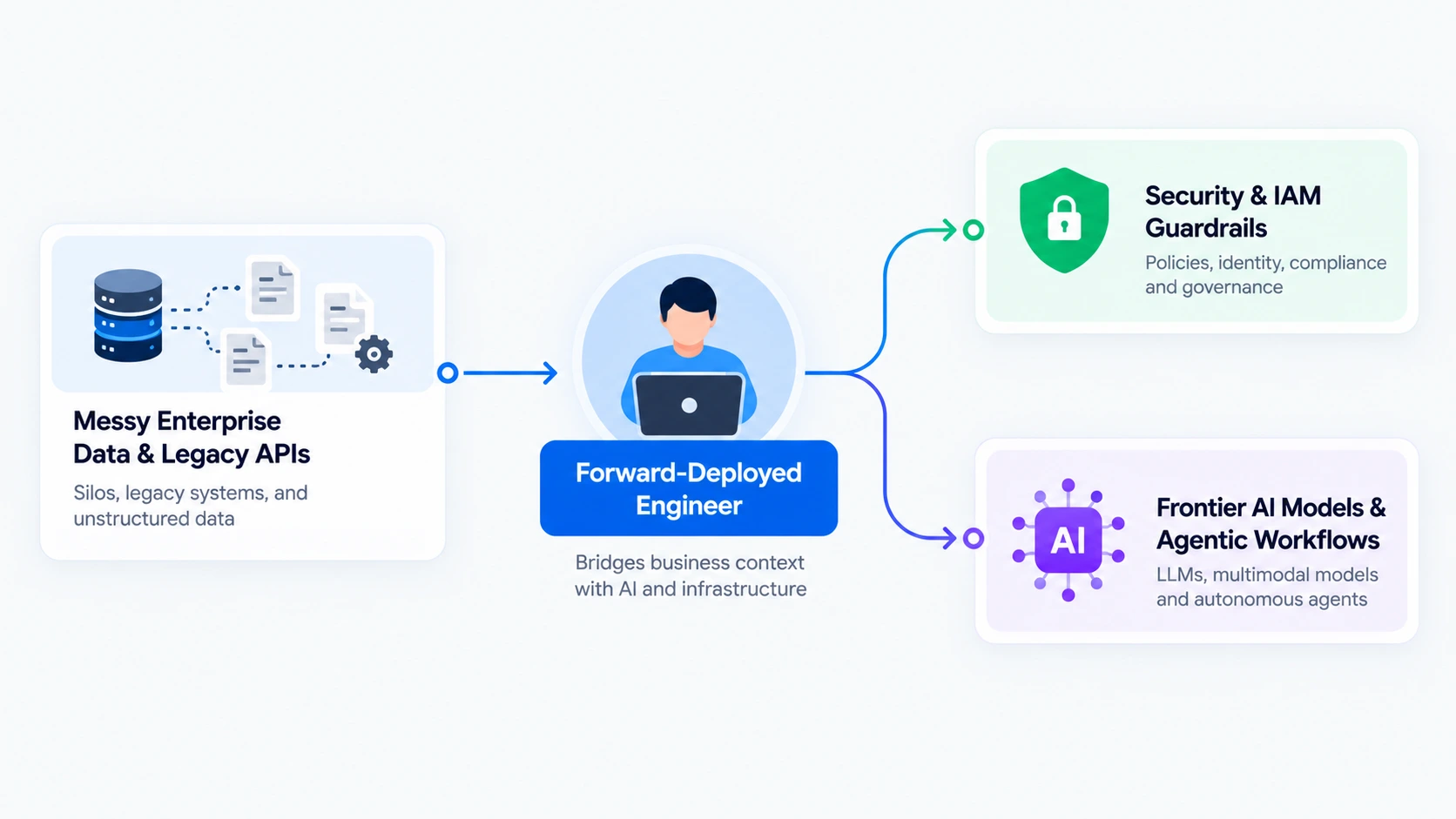
AI leaders are investing heavily in forward-deployed models for three key reasons:
- The “Last Mile” Integration Bottleneck: Enterprise data is messy, siloed, and heavily guarded. FDEs navigate legacy databases, custom internal APIs, and complex identity providers, like Okta or Entra ID, to unlock the context frontier models require.
- Accelerated Time-to-Value: By identifying technical blockers directly inside client infrastructure, forward-deployed engineers bypass months of back-and-forth architectural reviews, moving solutions into production in weeks rather than quarters.
- Continuous Real-World Feedback Loops: FDEs act as a direct channel between enterprise edge cases and core product teams. The integration challenges, edge-case failures, and safety requirements discovered on the ground directly inform future product roadmaps.
3. How Forward-Deployed Engineering Differs From Traditional Development
Understanding the distinction between traditional software delivery, IT consulting, and forward-deployed engineering helps clarify why FDE is uniquely suited for enterprise AI.
Comparison of Software Delivery Models
| Operational Dimension | Traditional Software Development | IT Consulting & System Integrators | Forward-Deployed Engineering (FDE) |
|---|---|---|---|
| Primary Location | Centralized R&D HQ or remote pods | On-site or offshore advisory teams | Embedded directly alongside client teams |
| Core Output | Standardized, multi-tenant software | Architecture decks & project roadmaps | Custom production code, API adapters & agent systems |
| Feedback Loop | Telemetry logs, tickets & user surveys | Periodic status reviews & milestone reports | Direct, real-time feedback embedded in the client stack |
| Problem Domain | General features for broad market | Process optimization & vendor selection | High-complexity, domain-specific edge cases |
| Code Ownership | Central product repository | Client-owned custom scripts | Hybrid: Client production code + core platform features |
4. Moving AI From Pilot to Production
A major challenge facing enterprise technology leaders is the “Pilot Trap”, getting stuck in endless proof-of-concept (PoC) loops that never make it to live production systems.
A project often works flawlessly in a sandbox environment using synthetic data, only to break down when exposed to real-world edge cases, rate limits, and security constraints. This issue frequently stems from a broader industry challenge, as discussed in our piece on why businesses need a multi-model AI strategy to avoid vendor lock-in and single-point execution failures.
The Pilot-to-Production Transition Matrix
| Stage | Focus Area | Core FDE Deliverable |
|---|---|---|
| 1. AI Pilot Sandbox | Initial concept testing & synthetic data validation | Rapid prototyping in isolated environments |
| 2. FDE Bridge Layer | Security, data governance, and cloud infrastructure alignment | Role-based access (RBAC), sandboxed compute, & MCP adapters |
| 3. Production Value | Live enterprise execution & business impact | Scalable agentic workflows with resilient fallback handling |
Forward-deployed engineering breaks through the pilot barrier by addressing core deployment hurdles up front:
- Security & Governance Alignment: FDEs design execution boundaries, such as role-based access controls (RBAC), sandboxed compute environments, and review-before-execute approval gates, directly within the client’s cloud security framework.
- Context Protocol Standardization: FDEs implement standardized context mechanisms, like the Model Context Protocol (MCP), ensuring AI models securely query internal enterprise tools without exposing raw database credentials.
- Resilient Failure Handling: Real-world AI applications require robust error recovery, rate-limit management, and model routing fallbacks. FDEs engineer these safeguards directly into the production pipeline.
5. How Codimite Supports Businesses Through Forward-Deployed Engineering
At Codimite, we recognize that modernizing enterprise cloud infrastructure and scaling autonomous AI agents requires more than generic off-the-shelf tools, it demands deep, hands-on engineering execution. Similar to how we guide organizations in our step-by-step Chrome Enterprise Premium migration guide, our focus is always on data-driven, practical deployment.
Through our forward-deployed engineering methodology, our senior technical teams work directly inside your cloud environments to convert complex technical challenges into secure, scalable operational value:
- Embedded Cloud & AI Expertise: Our engineers work alongside your internal architects to design, build, and deploy custom agentic workflow automation, multi-model infrastructure, and Google Cloud modernizations tailored to your unique stack.
- Production-Grade Governance & Security: Our forward-deployed teams help establish containerized compute isolation, granular role-based access controls, and real-time operational monitoring to ensure your AI deployments meet strict enterprise compliance standards.
- Zero-Disruption Integration: We engineer solutions that align directly with your existing CI/CD pipelines, security frameworks, and identity systems, moving your AI initiatives from initial architecture to full production confidence.