7 Questions Every CIO Should Ask Before Scaling AI Agents
AI agents are beginning to do more than answer questions. They update customer records, process documents, trigger workflows, and interact with enterprise applications, often with limited human involvement.
For CIOs, this creates a different kind of responsibility.
In 2026, 40% of surveyed large enterprises reported scaling AI agents, compared with 27% a year earlier. Adoption is accelerating, but deploying more agents does not automatically translate into greater operational efficiency.
The challenge is knowing what those agents can access, what decisions they make, and who remains accountable when something goes wrong.
Before expanding agentic AI across the enterprise, CIOs should be able to answer seven questions.
1. Do We Know Where AI Agents Are Operating?
An engineering team uses an AI coding assistant. Finance automates invoice processing. Sales connects an agent to CRM data.
Each deployment might make sense independently. The problem begins when IT cannot see how these tools operate across the organization.
This is an emerging form of shadow AI, where AI capabilities enter business workflows without consistent oversight.
An enterprise AI inventory should identify active agents, their owners, connected applications, data access, and execution permissions.
Without that visibility, organizations cannot properly assess security exposure, duplicated investments, or operational dependencies.
A useful test: Can your IT team identify every AI agent capable of modifying business data today?
2. What Can Each Agent Actually Do?
Not every AI agent requires the same level of access.
An agent summarizing customer feedback might only need read permissions. An agent processing refunds could require access to financial records and transaction systems.
Giving both broad permissions creates unnecessary risk.
Enterprise AI security should follow least-privilege principles, with each agent receiving only the access required for its assigned tasks.
Agent identities, permission boundaries, and approval requirements should be clearly defined.
The distinction matters because an AI agent capable of executing actions presents greater operational risk than one that simply generates recommendations.
3. Are AI Policies Enforced When Agents Take Action?
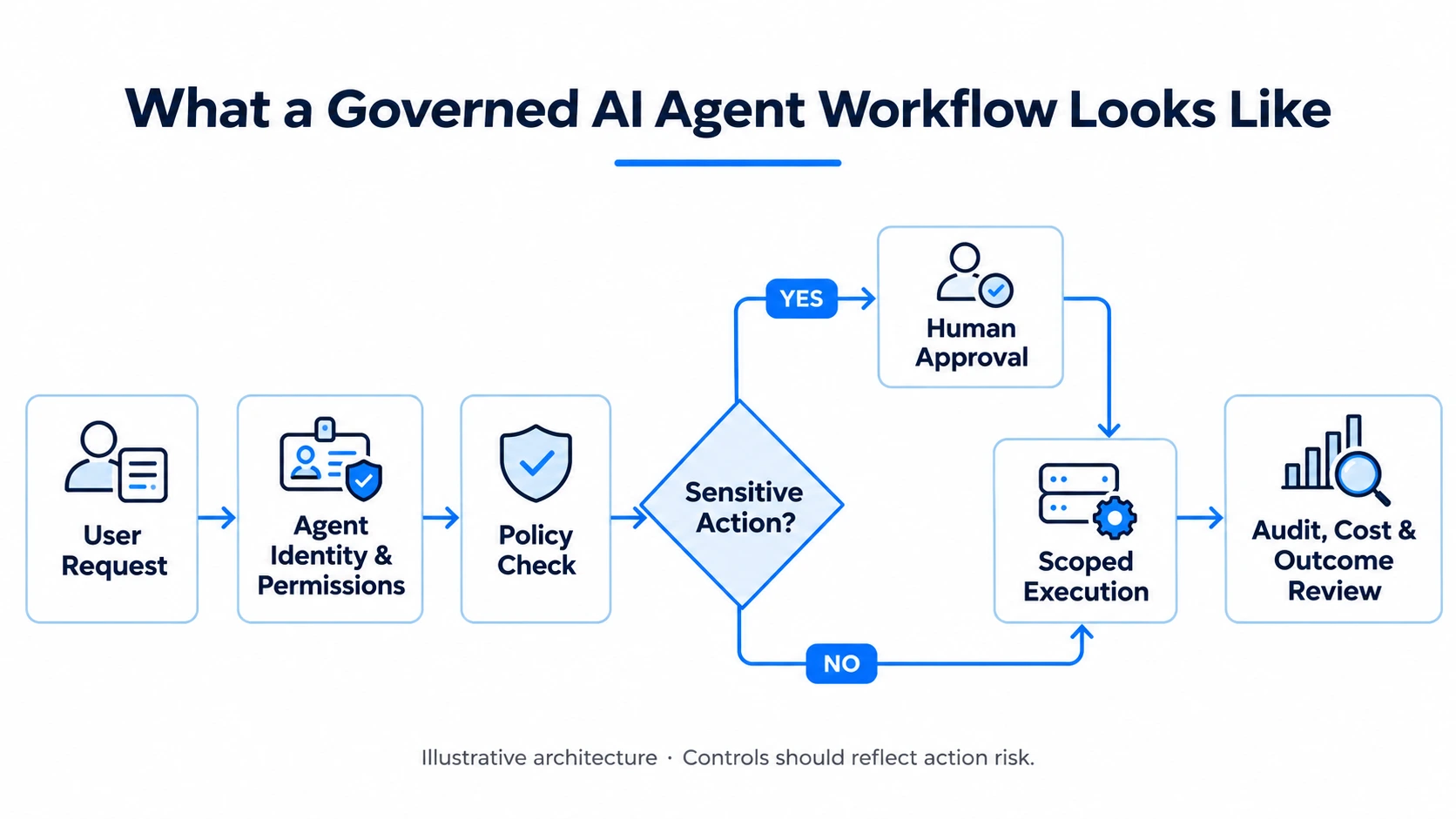
Many organizations have AI usage policies. But policies alone cannot prevent an agent from making an unauthorized API call.
This is where runtime AI governance becomes important.
Instead of relying entirely on periodic reviews, organizations need technical controls that evaluate permissions and enforce restrictions during execution.
Consider the difference:
| Traditional AI Oversight | Runtime AI Governance |
|---|---|
| Documents acceptable AI use | Enforces policies during execution |
| Reviews access periodically | Validates permissions before actions |
| Detects problems through audits | Blocks unauthorized operations |
| Relies on separate system logs | Connects actions with accountability |
For example, an agent could prepare a purchase order automatically while requiring human approval before committing funds.
This approach supports automation without surrendering control.
Enterprise AI orchestration frameworks, including those discussed in CommandLyne’s enterprise AI control approach, focus on connecting permissions, execution environments, and oversight.
4. Can We Explain Why an Agent Took a Particular Action?
Imagine an AI agent changes a customer’s account information overnight.
An application log might confirm that a record was updated. But can IT determine which agent made the change, what triggered it, and which information influenced the decision?
That requires more than conventional activity logging.
AI agent observability should connect requests, model interactions, tool calls, permissions, and execution outcomes.
For CIOs, this visibility supports incident investigations, compliance reviews, and operational troubleshooting.
It also raises an important question: Can the organization reverse an incorrect action or recover safely when an automated workflow fails?
AI accountability becomes meaningful when teams can reconstruct what happened and respond effectively.
5. Who Controls the Information AI Agents Remember?
AI agents increasingly use persistent context, including customer histories, internal documentation, previous conversations, and business decisions.
This improves continuity but introduces new governance concerns.
Where is that information stored? Who can access it? How long should it remain available?
Consider an AI agent supporting an account manager. If that employee leaves, valuable customer knowledge should not disappear with their personal workspace.
However, automatically sharing every interaction across departments creates privacy and security risks.
CIOs need clear boundaries between personal context, sensitive business information, and approved organizational knowledge.
Enterprise AI governance must cover what agents remember, not just what they execute.
6. Can We Connect AI Spending to Business Value?
An AI workflow might use several models, multiple API calls, external tools, and repeated attempts before completing a task.
That makes costs difficult to evaluate through token consumption alone.
CIOs need to understand the total cost of successful business outcomes.
For example, measuring the expense of processing one invoice provides greater insight than tracking the total tokens consumed by a finance agent.
Useful metrics include execution cost, task completion rate, processing time, human intervention, and rework.
Organizations should also assess whether complex models are necessary for every task.
Multi-model AI orchestration can help balance capability and cost, provided model selection and spending remain visible.
The goal is not simply cheaper AI. It is reliable automation with measurable financial value.
7. What Must Be Proven Before We Scale Further?
A successful pilot demonstrates potential. It does not guarantee enterprise readiness.
Production environments introduce unpredictable inputs, incomplete data, changing permissions, API failures, and competing business priorities.
Before expanding deployment, CIOs should establish measurable standards for reliability, security, cost, and operational accountability.
A 2025 industry forecast estimated that more than 40% of agentic AI projects could be canceled by the end of 2027 because of escalating costs, unclear business value, or inadequate risk controls.
That projection highlights the importance of testing real operational conditions rather than relying on demonstrations.
Scaling decisions should depend on proven outcomes, clear ownership, and documented recovery procedures.
Scaling AI Agents Requires Control, Not Just Capability
The next challenge for enterprise IT is not simply deploying more AI agents. It is managing how those agents interact with business systems, organizational knowledge, and one another.
CIOs need visibility across deployments, permissions that match business responsibilities, enforceable security controls, and reliable evidence of performance.
Solutions such as CommandLyne reflect the increasing focus on bringing AI agents, workflows, models, and enterprise governance into a connected operating environment.
Regardless of the platform chosen, the principle remains the same.
Before giving AI agents greater autonomy, enterprises need confidence in who controls them, what they can do, and how their actions are measured.
That foundation will determine whether agentic AI becomes a dependable enterprise capability or another layer of operational complexity.