Enterprise AI Agents on Google Cloud: A Production Architecture Guide

Enterprise AI is moving beyond chatbots that simply answer questions.
Organizations are increasingly building AI agents that can reason over a business objective, retrieve enterprise data, call APIs, use software tools, collaborate with other agents, and execute multi-step workflows.
That creates a different architectural problem.
A production AI agent is not simply:
Prompt → LLM → Response
A real enterprise architecture looks closer to:
User → Agent → Model → Knowledge → Tools → Enterprise Systems
with identity, governance, memory, security, evaluation, and observability surrounding the entire execution path.
Google Cloud’s Gemini Enterprise Agent Platform brings many of these capabilities into a unified environment for building, scaling, governing, and optimizing enterprise AI agents. It includes the Agent Development Kit, Agent Runtime, Sessions, Memory Bank, Agent Identity, Agent Registry, Agent Gateway, and observability capabilities.
What Is an Enterprise AI Agent?
An enterprise AI agent combines a foundation model with instructions, tools, business data, memory, and execution logic to complete tasks toward a defined objective.
Consider a procurement request.
Instead of simply explaining purchasing policy, an AI agent could:
- Interpret the request.
- Check internal procurement policies.
- Query inventory.
- Retrieve approved vendors.
- Compare pricing.
- Check budget limits.
- Request human approval.
- Submit an order through an ERP API.
- Record the action for auditing.
The LLM handles reasoning, but the surrounding infrastructure determines whether that reasoning can safely operate in production.
Production AI Agent Architecture on Google Cloud
A practical Google Cloud architecture can be divided into several layers.
| Layer | Technology | Role |
|---|---|---|
| Reasoning | Gemini models | Language understanding and reasoning |
| Agent logic | Google ADK | Agent behavior and orchestration |
| Runtime | Agent Runtime | Deployment and scaling |
| Knowledge | RAG / enterprise search | Grounding in business data |
| Tools | APIs / MCP | Enterprise actions |
| Agent communication | A2A | Agent-to-agent collaboration |
| State | Sessions | Conversation context |
| Memory | Memory Bank | Cross-session knowledge |
| Governance | Identity, Registry, Gateway | Access and policy controls |
| Operations | Cloud Observability | Logs, metrics and traces |
This separation is important because model intelligence should never equal unrestricted enterprise access.
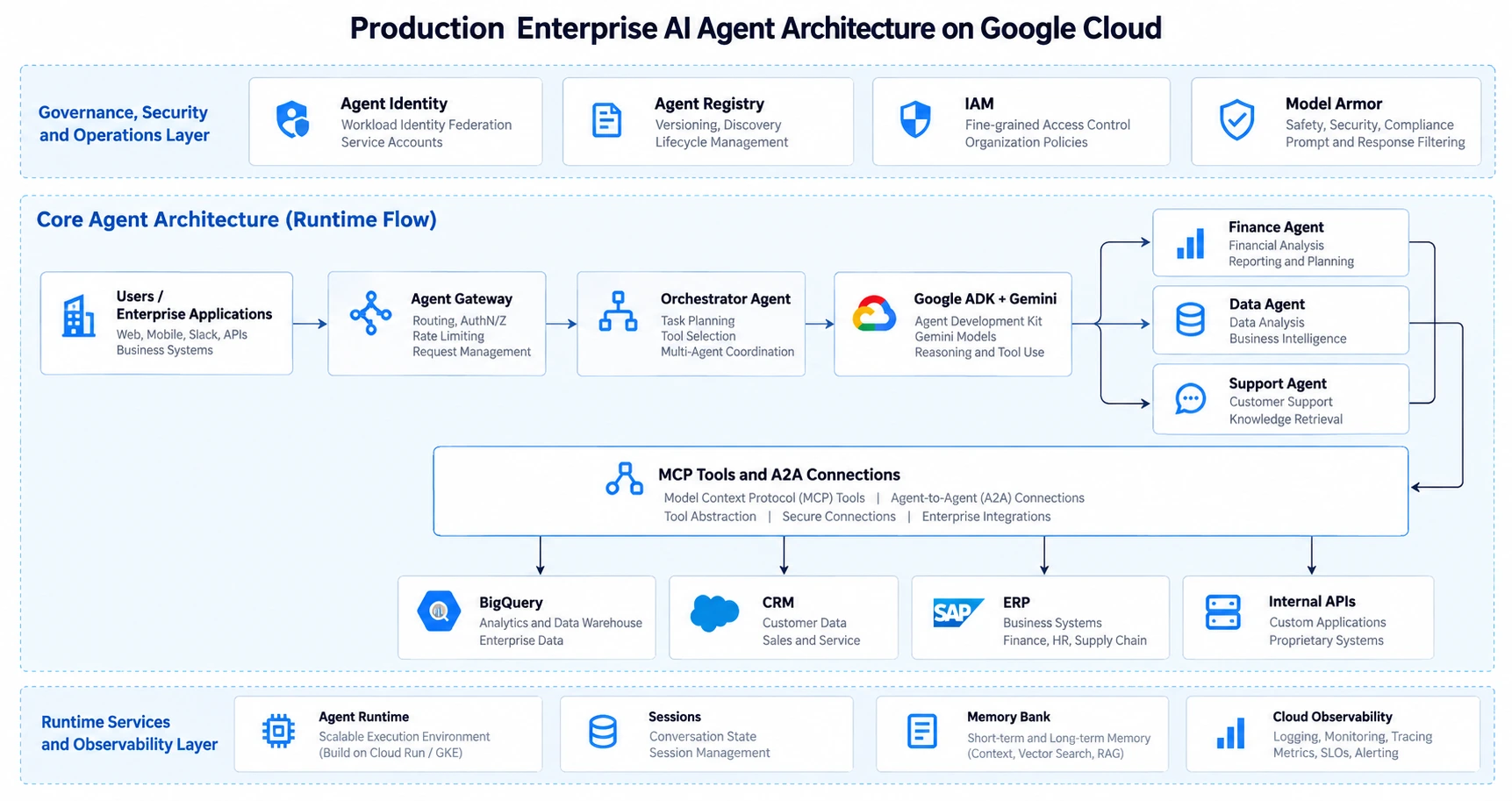
Around this execution layer sit Agent Identity, Memory Bank, Sessions, Model Armor, Agent Registry, IAM, logging, tracing, and evaluation.
1. Build Agent Logic with Google ADK
Google’s Agent Development Kit, or ADK, is designed for building sophisticated agents and multi-agent systems with control over tools, logic, and orchestration.
The important architectural principle is that not every workflow step should be controlled by an LLM.
A production application should combine:
Deterministic logic
Validate request → Check limits → Verify permissions
with:
Agent reasoning
Interpret intent → Select strategy → Choose appropriate tool
This limits unnecessary model calls and keeps predictable business rules deterministic.
For larger workloads, a multi-agent architecture can also be preferable to a single “super agent.”
Each specialized agent can have its own tools, permissions, instructions, and domain knowledge.
Google Cloud has specifically highlighted multi-agent architectures as enterprise workloads expand in complexity and tool count.
2. Deploy Agents on Agent Runtime
Prototype agents can run locally, but production agents need scalable infrastructure.
Google Cloud’s Agent Runtime is a fully managed environment for deploying, operating, and scaling agentic applications. It abstracts much of the underlying infrastructure so teams can focus on application and agent logic.
ADK agents can be deployed directly to Agent Runtime, while organizations can still use other infrastructure patterns when greater deployment control is necessary.
For enterprise architects, the deployment decision usually depends on:
- workload scale
- networking requirements
- latency
- compliance requirements
- dependency customization
- operational ownership
3. Ground Agents with Enterprise Data
An enterprise AI agent should not rely solely on the model’s pretrained knowledge.
It needs current organizational context.
That commonly requires retrieval-augmented generation, or RAG, where relevant information is retrieved before the model produces an answer.
User Request
↓
Retrieval
↓
Enterprise Knowledge
↓
Relevant Context
↓
Gemini
↓
Grounded Response
Knowledge sources might include internal documentation, CRM records, BigQuery datasets, policies, support knowledge bases, or product information.
Grounding turns a general-purpose model into an agent capable of reasoning over enterprise-specific context.
4. Connect AI Agents to Tools with MCP
Enterprise agents become valuable when they can perform actions.
Examples include:
query_customer()create_ticket()check_inventory()update_crm()run_query()submit_order()
The Model Context Protocol, or MCP, provides a standardized approach for connecting AI agents with tools and external systems.
In architectural terms:
MCP = Agent ↔ Tool
That could allow a specialized agent to work with data platforms, APIs, cloud services, or internally developed enterprise tools without embedding every integration directly into agent logic.
5. Use A2A for Multi-Agent Communication
MCP should not be confused with Agent2Agent, or A2A.
A2A addresses communication between autonomous agents.
MCP
Agent → Tool
A2A
Agent → Agent
Google describes A2A as a standardized approach that enables independent agents to discover capabilities and interact with each other.
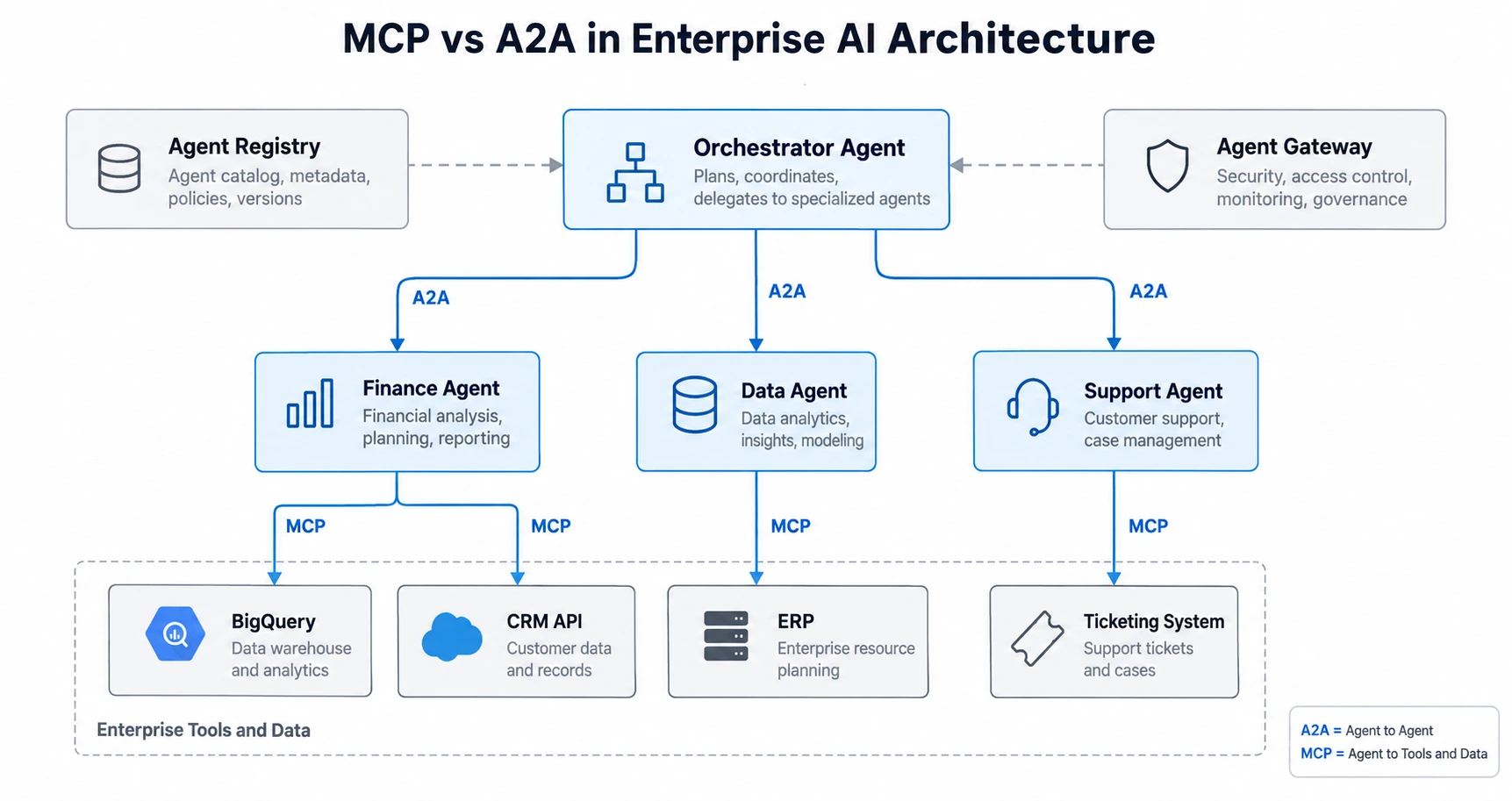
As enterprise AI grows, both protocols can appear in the same architecture: A2A for collaboration and MCP for execution.
6. Design Memory and Identity Deliberately
Google Cloud separates active interaction state from persistent memory.
Sessions maintain context for an ongoing conversation, while Memory Bank can retain and retrieve relevant information across multiple sessions.
That distinction matters because persistent memory needs governance.
Teams should explicitly define:
- what information agents may remember
- retention policies
- who can retrieve memories
- what data must never become persistent
Identity is equally important.
Agent Identity gives individual agents unique identities so access controls can be applied at the agent level rather than allowing every agent to operate through broadly privileged shared credentials.
7. Govern and Observe Every Agent Action
Once agents can interact with business systems, policy enforcement becomes essential.
Agent Gateway provides a centralized control point for agent interactions and tool calls, while Agent Registry provides a catalog for agents, tools, and MCP servers.
Observability must also go beyond traditional application monitoring.
Enterprise teams need to trace:
- which agent handled a request
- which model was called
- which tool was selected
- latency per step
- token consumption
- agent-to-agent calls
- errors and failed actions
Google Cloud’s agent observability stack uses OpenTelemetry-compatible traces alongside logs and metrics to provide visibility into deployed agents and MCP servers.
From AI Agents to Controlled Autonomy
The goal of enterprise AI should not be unlimited autonomy.
It should be controlled by autonomy.
A strong Google Cloud architecture separates model reasoning from system permissions, tool access, enterprise data, memory, and governance.
The production pattern becomes:
Gemini for reasoning → ADK for orchestration → Agent Runtime for execution → RAG for enterprise knowledge → MCP for tools → A2A for agent collaboration → Identity and Gateway for governance → Observability for operational control.
That surrounding architecture is what transforms an AI prototype into a production-ready enterprise AI agent system.
For organizations exploring agentic AI and workflow automation, Codimite can connect this architecture with broader Google Cloud engineering, enterprise integration, application development, and modernization initiatives, allowing AI agents to become governed participants in real business workflows.