Google Launches EmbeddingGemma 2: Multimodal AI Moves Directly to Your Device
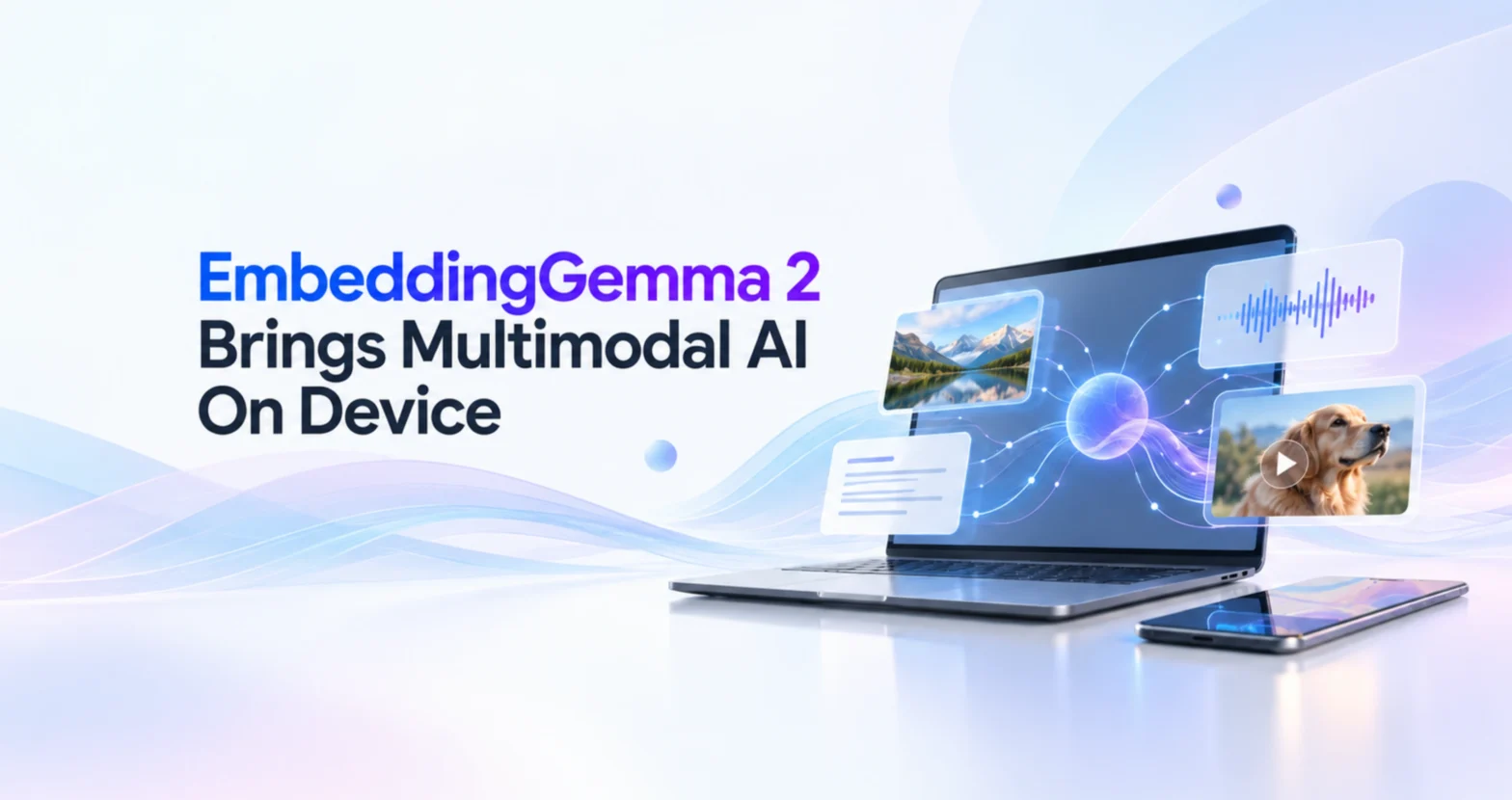
Google has introduced EmbeddingGemma 2, a new open multimodal embedding model designed to bring powerful AI search, retrieval and understanding directly to everyday devices.
Announced by Google and highlighted by CEO Sundar Pichai, EmbeddingGemma 2 is Google’s first open, natively multimodal embedding model. It can process text, code, images, video and audio within a lightweight, modular architecture of just 740 million parameters. Google is positioning the model specifically for on-device AI, where privacy, latency and computing efficiency matter.
The announcement signals another important shift in artificial intelligence. Instead of every AI task depending on large cloud-hosted models, more intelligence can increasingly operate locally on phones, laptops and other edge devices.
What Is EmbeddingGemma 2?
EmbeddingGemma 2 is an open multimodal embedding model developed by Google DeepMind.
Embedding models work differently from traditional generative AI models. Rather than primarily generating text, they convert information into mathematical representations called embeddings. These representations allow AI systems to understand how different pieces of information relate to one another.
What makes EmbeddingGemma 2 particularly significant is its ability to place multiple types of information into a single 768-dimensional embedding space.
That means text, software code, images, video frames and audio can all be compared semantically within the same system.
For example, an application could potentially use a voice description to locate a particular moment inside a video, search a collection of images using natural language, or find related information across documents, recordings and visual assets without relying on separate AI models for every format.
A 740M Model Designed for On-Device AI
One of the biggest advantages of EmbeddingGemma 2 is its relatively small footprint.
The full multimodal model contains 740 million parameters, but its modular architecture means developers do not always need to load the entire model.
Google describes configurations ranging from approximately 270M parameters for text and code, to 440M with vision, 570M with audio, and the complete 740M configuration when all modalities are required.
According to Google’s testing on the Pixel 11 Pro, the model can require approximately 191MB of active RAM for text-only weights and around 567MB for the complete multimodal model when quantized.
Those numbers matter because they make sophisticated semantic retrieval much more practical on consumer hardware rather than requiring every request to travel to a cloud AI service.
Why Offline and Privacy-First RAG Matters
One of the most interesting use cases for EmbeddingGemma 2 is on-device Retrieval-Augmented Generation, or RAG.
RAG allows an AI system to retrieve relevant information before generating an answer. In enterprise environments, it is commonly used to ground AI responses in internal documents, knowledge bases and other trusted information.
Traditionally, building these systems often means transmitting data between devices, embedding APIs, vector databases and cloud-based language models.
EmbeddingGemma 2 opens another path.
Because embeddings can be generated locally, applications can perform semantic search and retrieval without automatically sending source information to a remote server. Google specifically positions the model for privacy-first and offline applications, particularly when combined with Gemma 4 for local reasoning and generation.
For developers working with sensitive files, personal media, enterprise documents or applications with limited connectivity, this architecture could become increasingly valuable.
One Model for Text, Images, Audio and Video
Another significant development is the consolidation of previously separate AI pipelines.
A multimodal application might traditionally require one system for speech recognition, another for understanding images, another for generating text embeddings and additional infrastructure to connect the results.
EmbeddingGemma 2 is designed to reduce that complexity by creating compatible embeddings across all supported modalities.
Google gives examples including searching media libraries using text or images, locating specific moments inside videos through text or audio queries, and building real-time classification and routing systems.
The model also includes an 8K-token context window, allowing it to process longer inputs. Google says this can accommodate up to roughly 5.5 minutes of audio, 29 images or 58 video frames, depending on the workload.
This makes multimodal retrieval possible without forcing developers to break every interaction into completely separate systems.
Google Is Also Targeting Better Storage Efficiency
Embedding systems can become expensive at scale because organizations may need to store millions of vectors.
Google is addressing this through Matryoshka Representation Learning, which allows EmbeddingGemma 2’s standard 768-dimensional vectors to be reduced to smaller representations such as 512, 256 or 128 dimensions.
Depending on the configuration, Google says this can significantly reduce vector storage and memory requirements while retaining much of the original retrieval quality.
For developers building large local knowledge bases, semantic search engines or enterprise AI applications, lower storage requirements could make embedding-based systems considerably easier to deploy.
How Does EmbeddingGemma 2 Perform?
Google says EmbeddingGemma 2 achieves leading performance among multimodal embedding models below one billion parameters while competing with some significantly larger specialist models.
One notable improvement is code understanding. On the MTEB Code benchmark, Google reports the model improving from 68.76 with the previous EmbeddingGemma to 78.68 with EmbeddingGemma 2, a gain of 9.92 points.
The company is also making the model broadly accessible. EmbeddingGemma 2 uses an Apache 2.0 license, and model weights are available through platforms including Hugging Face and Kaggle. Support is also planned for Google’s Gemini Enterprise Agent Platform Model Garden.
What EmbeddingGemma 2 Means for the Future of Enterprise AI
EmbeddingGemma 2 represents a broader trend: enterprise AI architecture is becoming increasingly distributed, multimodal and context-aware.
Not every workload needs a massive frontier model operating in the cloud. Some tasks may be handled more efficiently on-device, while complex reasoning or execution can still be routed to larger AI systems.
That makes orchestration increasingly important. Enterprises will need to determine which models should handle which tasks, what information each system can access, where processing should happen and how AI activity is governed.
This is also where platforms such as CommandLyne become relevant. CommandLyne focuses on bringing AI models, agents, workflows, enterprise context and governance into a unified orchestration layer, including the ability to route work across approved models rather than relying on a single AI provider.
As models like EmbeddingGemma 2 make local AI more capable, the future may not be about choosing between cloud AI or on-device AI. It may be about intelligently coordinating both, using the right model, context and execution environment for each task.